7 Tests (for Older Dummies):
Are you already on the road to Disability?
(in your older/future years)
The Older years: A sad place for most:
Let’s face it: for the majority of our current batch of oldies, the older years have turned out to be more than a bit of a sad, sad place.

And we can see it with our own eyes. Often, daily.
But we, are we treading the same path?
It begins in the 50s and 60s when we start noticing that we are getting weaker.
But, too often we think: “Well, I’m getting old/er now, so let me grin and bear it, cos’ that’s the way things are meant to be…”.
Or worse still, we don't notice that we’re going downhill.
Or, yet again, we think: "That’s the way things are meant to be…” This is not true, because…
The future Oldie is going to be more Magnificent* than today’s Oldie.
*Magnificent = Empowered, Fast, Capable, Independent, Free. Plus, looking great!
The times, they are a changin'.
Look, there’s a new world out there, as some of us may have noticed.
And scientific innovations have come roaring in, riding on the back of questioning (asking questions like “What if there was a better way to age?”), imagination (“How can the future be better for older people?”) and the consequent research.
And the result? We have Scientific findings about Ageing in general: how things work to worsen our state as we age, and what strategies work to keep us humans up in the higher regions of health and performance.
And you can bet that these scientific findings are going to (sooner or later) seep into the way of life of most people around us.
It’s called the diffusion of Knowledge.
Hence,
the Future Oldie is going to be in a much better place than the oldie of today:
because of knowledge and proactivity (taking action well in time).
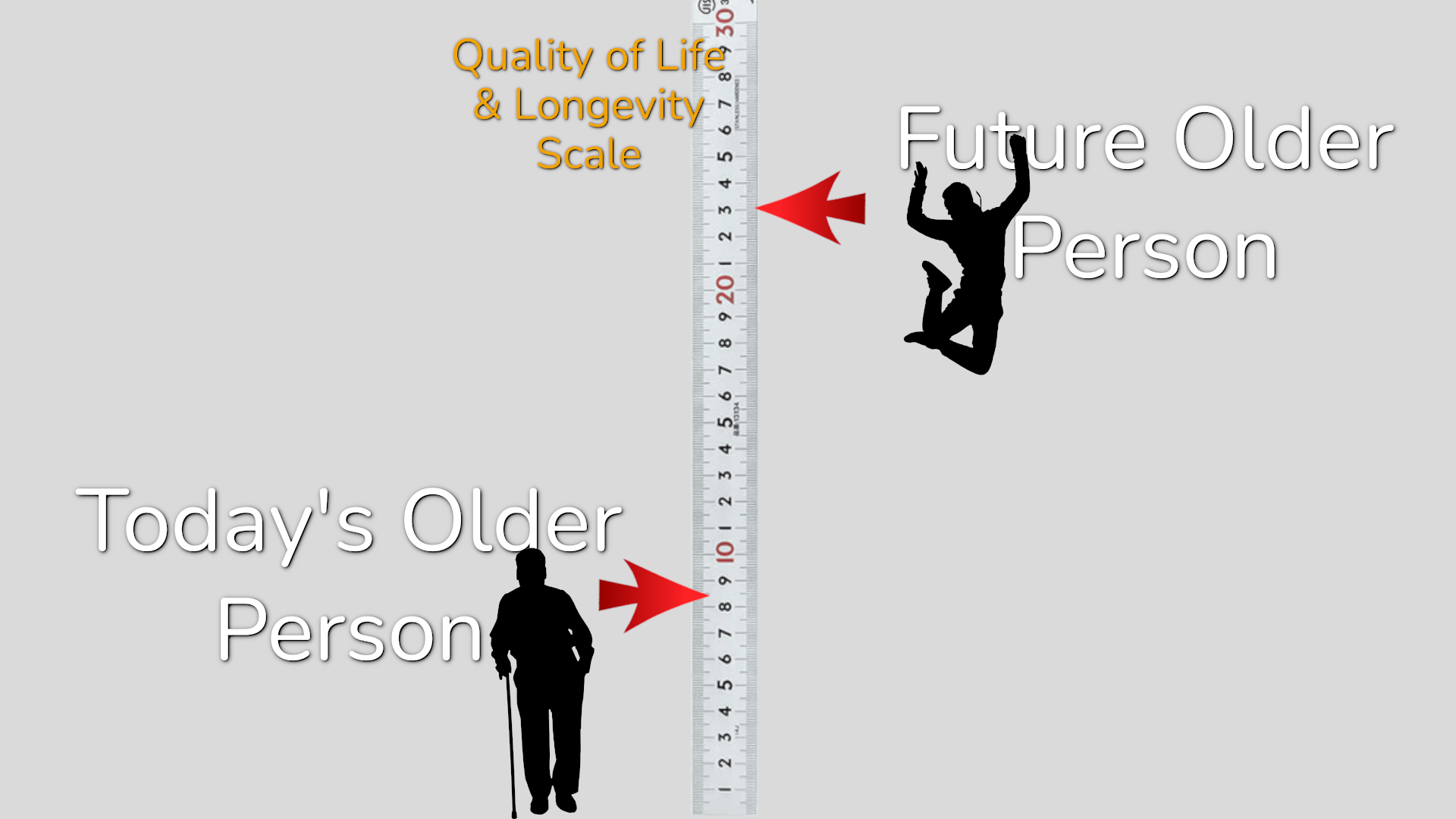
But let's get it straight: right now, that “Future Oldie” is not you.
Unless …
* you figure out (or research) the ‘knowledge’ part, and
* you take on the ‘proactivity’ (taking-action-in-advance) part.
Sadly, if you don’t know what you need to do for the years ahead (that is, you don’t know how to prepare for the years ahead, and/or you don’t have a plan and strategy for a truly poweful you), you are missing out on the opportunity to optimize your future.
While you still can. (Beware the Drop-Off).
Because time waits for no man or woman.
You see, the further away you are from 50, the closer you are to that Disability Threshold.
(Because naturally, you're sliding down that red-lined steeply-downward slope.)

And you need to implement that your new-found knowledge and well-planned strategy about ageing well, right now, well before you hit that Disability Threshold.
(I call that line "the Drop-off", the region beyond which there is no getting back to being Capable or Independent again).
That’s why you need the Education, Coaching, Tools and Strategy NOW.
(Check out this link for further details).
And also because…
If, at this stage of your life, you’re already feeling the disability creeping in, picture what will happen to you when you start accelerating down the steeper parts of that downhill graph?
Notice that Disability Threshold?
Once over that line, here’s no clawing your way back to being capable and/or independent again, however much money or will power you have. (Whether you have tons of money to spend on fixing your problem/s makes no difference then.)
So become very aware that you don’t have the luxury of time.
Let’s wake up to the Facts about the way we are ageing:
Right now, become aware whether the actions you are taking today are moving you towards the bad place, or towards the good place (the ‘Green’ side in the graph above).
PS: the bad place is below the Disability Threshold line. The good place is in the Green area.
So how do you “become aware” (know) if you’re doing the right things for yourself right now?
Only by testing your body, checking its current status, how it is doing right now.
Because your body’s current status will tell you if you’re “doing the right things”. Or the wrong things.
(And once we know what's happening, perhaps you can fix the situation).
So, let’s get testing:
In the following section are 7 moves you need to be able to perform competently, today, and every day of the rest of your life. Of course, only if you want to be that Magnificent-Amazing older-you that you were meant to be.
(This is the minimum standard I expect all who go through the “groeVolve Ageing via Intelligent-Design” course to achieve and maintain till the day they drop.)
________________
The Full Squat
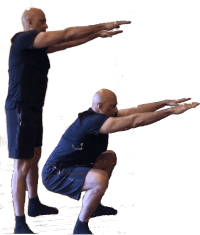
The Full Squat will test the strength of your legs and backside in general, as well as your hip mobility.
If you can’t drop to a horizontal upper-thigh position today (and, of course, get back up easily), you need to start doing something about it immediately.
Here’s the criteria:
1. You have the confidence to even attempt to squat.
2. You can squat to a position where your thighs are parallel to the floor.
3. You shouldn’t need to hold on to any support, both, while lowering yourself, and while getting back up to a full stand.
4. You can put your hands out in front of you while squatting.
5. You can even bear some load (on your back or on your front.)
Give yourself a mark for each.
(I regularly squat 130Kg - 286 lbs - for 4-5 repetitions. And just today, as I write this, I squatted 140Kg - 308 lbs -for 4 repetitions. )
(Check out the video above).
Through the years ahead, you must be highly aware of the need for a strong (indeed, the word I use is ‘Powerful’) lower body.
The Hinge
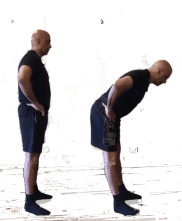
The Hinge tests the strength of your glutes, hamstrings and (especially lower) back, as well as your core.
Many older people can’t confidently reach out.
They lose stability, tumble & fall, and a fall leads to a shortened lifespan or reduced quality of life.
(In fact, a broken hip can kill you within a year and a half[1]).
Here’s the criteria for success with this movement:
1. You have the confidence to even attempt to bend forward.
2. You can bend forward to a position where your upper body is at 45 degrees or lower .
3. You don’t need to hold on to anything.
4. You can even bear some load (on your back or on your front.)
The Lunge
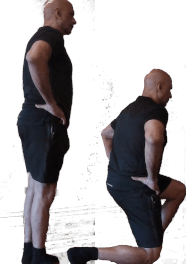
The Lunge is a move demanding core and glute-ham strength.
Especially because it also involves returning smoothly back to the start.
It’s a great indicator of whether you’re going to be independent in the future. Or not.
Here’s the criteria:
1. You have the confidence to even attempt to Lunge.
2. You can Lunge forward and come back to the start.
3. You don’t need to hold on to anything.
4. You can perform multiple lunges one after another.
5. You can even bear some load (on your back or on your front.
The Australian Pullup
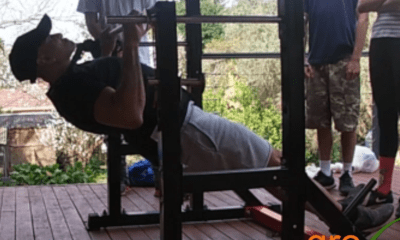
The Australian pullup indicates the strength of your upper back. It’s a move that you need to be able to perform. Today. And into the future.
Here’s the criteria:
1. You have the confidence to even attempt to do this one.
2. You can hold your weight on the bar.
3. You don’t need any assistance
4. You can get your chest pretty close to the bar.
5. You can perform multiple repetitions.
The Pushup
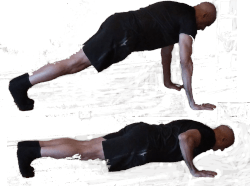
The Pushup is a chest/tricep/frontal-deltoid test, yes, the pushing muscles of your upper body.
Are you strong enough to push away the disability, and the dependence that too often is a part of the older years?
For the purposes of this test, women can test themselves from their knees, men on their toes.
(But I want all women who undertake the Ageing via Intelligent Design course to be able to perform the pushup while on their toes.)
Here’s the criteria:
1. You have the confidence to even attempt to do a pushup
2. You can hold your weight off the ground with your arms bent slightly at the elbow.
3. You don’t need any assistance
4. You can get your chest right down to the floor and back up again
5. You can perform multiple repetitions.
The Brace/Plank
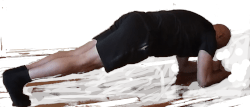
The Brace test (or plank as it’s more popularly called) is a static, isometric hold that indicates how well your core (the collection of muscles, large and smaller, that surround your chest and rib-cage) is doing its job. These muscles help you keep upright and also help to bring yourself upright from a lying or sitting position.
Here’s the criteria:
1. You have the confidence to even attempt to do this one.
2. You can hold your body horizontal.
3. You don’t need any assistance to keep yourself away from the floor.
4. You can be in a position with your body straight-line horizontal .
5. You can perform this multiple times.
6. You can hold yourself in this position for 2 or more minutes.
The Rotation
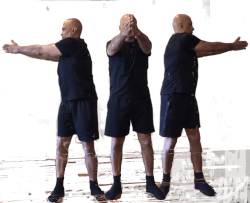
The Rotation movement tests your flexibility, so important to help your muscles work and grow. Lose your mobility (in any area of your body) at your peril. The more disabled you are, the less you can twist yourself around to each side.
Good mobility helps to stretch and grow your muscles, and just as importantly, is an indicator of the current state of your body.
The more immobile you are, the lower on the fitness scale you are. It’s just that simple.
And now we know how we're travelling towards our older years:
If you can perform these 7 movements competently today, right now, then you're doing the right things for yourself, going forward into your older years. Congratulations!
But if you can’t perform these movements satisfactorily right now, then it’s time to lift your game, if you want a better quality of life in the years ahead.
Because being disabled and disempowered for decades is something you seriously don’t want.
You can break through to the Best You possible, with the right help.
Click here if you want better than the direction you’re headed in right now.
Yes, You too Can.
Choose what you do now wisely. (There's not too much time...)
Take care and lots of love.
Mel Drego
groeVolve.com
Become an unstoppable older You.
________________
[1] https://theconversation.com/why-hip-fractures-in-the-elderly-are-often-a-death-sentence-95784
